 how-to
How Much Does Solar Pool Heating Cost? 2026 Guide
Table of Contents
- Solar Pool Heating Cost: What Determines Your Price
- Solar Pool Heater Installation Cost: Equipment and Labor Breakdown
- Solar Pool Heater Operating Cost: What You Pay After Installation
- Solar Pool Heater vs Gas Heater Cost: A Side-by-Side Comparison
- Solar Pool Heater Payback Period and Lifetime Ownership Cost
- Permits, Roof Condition, and Installation Constraints
- How to Get an Accurate Quote for Solar Pool Heating Cost
- Frequently Asked Questions
Last Updated: October 6, 2026
Solar Pool Heating Cost: What Determines Your Price
Solar pool heating cost is the total you pay to buy, install, and run a system that uses the sun's energy to warm your pool water.
Most guides quote a single number, but a small above-ground pool and a large in-ground pool sit at opposite ends of the range. Your climate, roof, and desired swim season all move the final figure.
Pool Size and Surface Area
Your pool's surface area, not its depth, sets the baseline for system size. Collectors are sized as a percentage of the water's surface, so a larger surface needs more panels. A sunny pool in a warm climate can use a smaller ratio; a shaded or wind-exposed pool needs more collector area. Measure length times width first.
Collector Area and System Size
Collector area is the total square footage of panels that capture sunlight and transfer heat to your pool water. More collector area means faster warm-up and a longer season, but it raises equipment and labor cost. Systems generally cover a meaningful share of the pool's surface area, with the exact ratio depending on your climate and target water temperature.
Solar Pool Heater Installation Cost: Equipment and Labor Breakdown
Solar pool heater installation cost splits into equipment and labor. Equipment covers the collectors, mounting hardware, plumbing, a pump or valve to divert water, and controls.
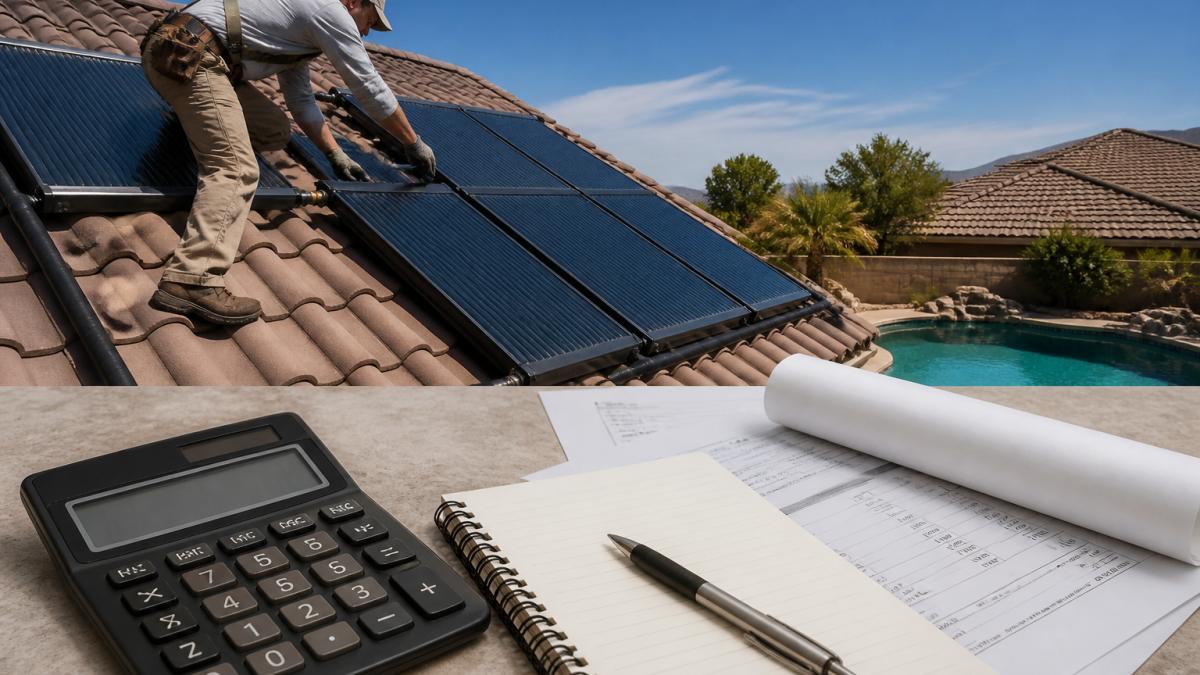
Seeing what each line item represents as a share of the total helps you tell whether a bid is padded or lean.
Cost Component | What It Covers | Typical Share of Installed Price | What Moves It Up or Down |
|---|---|---|---|
Collectors | Unglazed or glazed panels, absorber, frame | Largest single line | Panel type, total collector area, brand |
Mounting hardware | Racks, straps, rails, roof or ground anchors | Small to moderate | Roof material, ground frame vs. roof, wind rating |
Plumbing and valves | Supply and return lines, diverter valve, check valve, fittings | Moderate | Distance from pool to collectors, trenching, freeze protection |
Pump and controls | Booster or existing pump, controller, sensors | Moderate | Whether you reuse an existing pump or add one |
Labor | Mounting, plumbing tie-in, testing, cleanup | Often the second-largest line | Roof pitch and access, system size, site complexity |
Permits and inspection | Local approval, inspection fees | Usually small | Jurisdiction, roof vs. ground placement |
A common mistake is choosing the cheapest panels to lower the equipment line, then paying more in labor and callbacks later.
What a Quote Should Actually Include
A bid that only states a total price is not one you can compare.
When you line up two or three quotes this way, the differences stop being about the bottom line and start being about what you're buying. A lower total with a smaller collector area or a one-year labor warranty is not the same product as a properly sized array with a longer workmanship guarantee.
Cost Component | What It Covers | What Moves It Up or Down |
|---|---|---|
Equipment | Collectors, mounting, plumbing, pump, controls | Panel type, collector area, control features |
Labor | Mounting, plumbing tie-in, testing, cleanup | Roof access, system size, site complexity |
Permits | Local approval and inspection | Local requirements, roof or ground placement |
Operating | Pump electricity over the season | Pump efficiency, run time, climate |
Roof-Mounted vs. Ground-Mounted Installation
Roof-mounted systems put collectors where they catch unobstructed sun and stay out of the way. Ground-mounted systems sit on racks at ground level, suiting pools where the roof is shaded, too small, or the wrong shape. Roof mounting often costs less in materials because the roof provides the structure, but more in labor if access is tricky. Ground mounting gives more control over angle and sun exposure, though it takes yard space and needs its own frame.
Solar Pool Heater Operating Cost: What You Pay After Installation
Solar pool heater operating cost is usually the smallest line in the budget because the sun does the heating. The main ongoing expense is electricity to run the pump that pushes water through the collectors. A more efficient pump and smart controls cut that further by running only when the sun is strong enough to add heat. Beyond electricity, budget for occasional maintenance: checking for leaks, clearing debris, and inspecting panels and plumbing.
Solar Pool Heater vs Gas Heater Cost: A Side-by-Side Comparison
Solar pool heater vs gas heater cost is where the decision usually gets made. A gas heater has a lower upfront price and heats fast regardless of weather, but it burns fuel every time you use it, and that bill recurs all season.
Factor | Solar Heater | Gas Heater |
|---|---|---|
Upfront cost | Higher | Lower |
Operating cost | Very low | Recurring fuel bill |
Heating speed | Slower, weather-dependent | Fast, on demand |
Best for | Long seasons, low running costs | Quick heat, short use |
For homeowners who want to extend their season and cut monthly bills, solar usually wins on lifetime cost. For someone who heats a pool a handful of times a year, a gas heater can still make sense.
Solar Pool Heater Payback Period and Lifetime Ownership Cost
Solar pool heater payback period is the time it takes for your energy savings to equal what you paid to install the system. Because solar operating costs are low, each season you avoid gas or electric heating puts money back in your pocket, adding up to a lower total ownership cost than a fuel-burning heater even though solar costs more on day one.
Here is how to run the math for your pool.
How to Estimate Payback in Four Steps
- Find your current seasonal heating cost. Pull last year's gas or electric bills for the months you heat the pool and add up the heating portion. If you can't isolate it, use the heater's rated input and run hours as a stand-in.
- Estimate your solar operating cost. This is mostly the electricity to run the pump through the collectors. A variable-speed pump run during peak sun hours uses far less power than a single-speed pump, so the pump you pair with the collectors matters as much as the collectors themselves.
- Subtract operating cost from current heating cost. The difference is your annual savings. If you currently spend nothing to heat the pool, your savings are the value of the extra swim days you gain, not a bill reduction.
- Divide installed cost by annual savings. That gives payback in years. A system that saves more per season pays back faster, which is why pools used heavily through a long season see the shortest payback.
Lifetime Ownership Cost: The Number Quotes Leave Out
Lifetime ownership cost is the number that matters most, and the one most quotes leave out. Add the purchase price, operating cost across the years, and any maintenance, then compare that total against a gas or heat pump system over the same period.
Solar pool collectors have no burner, no heat exchanger to corrode, and few moving parts, so their service life is measured in many seasons rather than a few.
Factor | Solar | Gas | Heat Pump |
|---|---|---|---|
Upfront cost | Highest | Lowest | Moderate |
Operating cost | Lowest (pump electricity only) | Highest (recurring fuel) | Moderate (electricity) |
Lifespan of main equipment | Long, few moving parts | Shorter, combustion components wear | Moderate, compressor has a service life |
Sensitivity to weather | High | Low | Moderate |
Best fit | Long season, low running cost | Occasional quick heat | Mild climate, moderate use |
What Shortens or Lengthens Payback
Three levers move payback more than anything else. First, how much you currently spend to heat the pool, the higher your bill, the faster solar pays back. Second, how long your swim season is; a pool used most of the year racks up savings faster than one used a few weekends. Third, how well you keep heat in the water.
For a defensible number rather than a guess, ask each installer to show their assumed operating cost per season and the collector area behind it.
Permits, Roof Condition, and Installation Constraints
Permits, roof condition, and site constraints can add cost or rule out an option entirely, and they're easy to overlook until an installer raises them. Many areas require a permit and inspection for pool heating work, so check with your local building department before you commit. Your roof's age, material, and structural condition matter too: a roof near the end of its life may need attention before panels go on it.
How to Get an Accurate Quote for Solar Pool Heating Cost
An accurate quote starts with a site visit, not a phone estimate. Any provider who gives a firm number without seeing your pool, roof, and plumbing is guessing. Use this checklist:
- Ask for equipment and labor itemized separately
- Confirm the collector area and the ratio to your pool's surface
- Get the mounting method in writing, roof or ground
- Ask who handles permits and inspections
- Request the estimated operating cost per season
- Confirm the warranty on panels, plumbing, and labor
For the current cost of a system sized to your pool, consult the U.S. Department of Energy's guidance on solar pool heating and then get a local site assessment. The Database of State Incentives for Renewables & Efficiency tracks programs by location, and your installer should help you check eligibility.
As documented in ENERGY STAR's guidance on pool pumps and heating, the pump you pair with your collectors affects how much you spend to run the system.
Solar Pool Heating Texas handles residential and commercial installations and repairs, offers a 100% satisfaction guarantee, and is available 24/7 for emergency repairs.
Heating a pool shouldn't mean watching a fuel bill climb every month.
Frequently Asked Questions
How much does a solar heater for a pool cost?
The total solar pool heating cost depends on your pool's size, the collector area required, and whether you choose roof-mounted or ground-mounted panels. Equipment and labor are the two main components of the price. Because every pool is different, the most reliable way to get a real number is to request a site assessment. Solar Pool Heating Texas offers free consultations and can provide a quote tailored to your pool and roof setup.
What affects the cost of installing a solar pool heating system?
Several factors drive solar pool heater installation cost: pool surface area (which determines how many panels you need), roof size, shape, and condition, whether the system is roof-mounted or ground-mounted, local permit requirements, and the complexity of plumbing runs to your pool equipment pad. A larger pool needs more collector area, which increases both equipment and labor. Roofs that need reinforcement or have unusual angles can also add to the installation cost.
How much can solar pool heating save on energy bills?
Solar pool heating can significantly reduce or eliminate the electricity or gas costs of heating your pool, since the sun does the work once the system is installed. The exact savings depend on your current fuel source, local energy rates, and how often you heat your pool. Homeowners who currently pay high monthly bills for gas or electric pool heating often see the most dramatic reductions. A solar pool heater operating cost is primarily limited to running the existing pool pump.
Is solar pool heating worth the upfront cost?
Whether solar pool heating is worth it comes down to your solar pool heater payback period and how long you plan to stay in your home. Solar systems have low operating costs and can last for many years, so the initial investment is typically recovered over time through avoided energy bills. Compared to a gas heater, solar pool heater vs gas heater cost favors solar over the long run because there is no ongoing fuel expense. Homeowners who use their pool frequently and want to extend the swimming season often find the math works in their favor.